
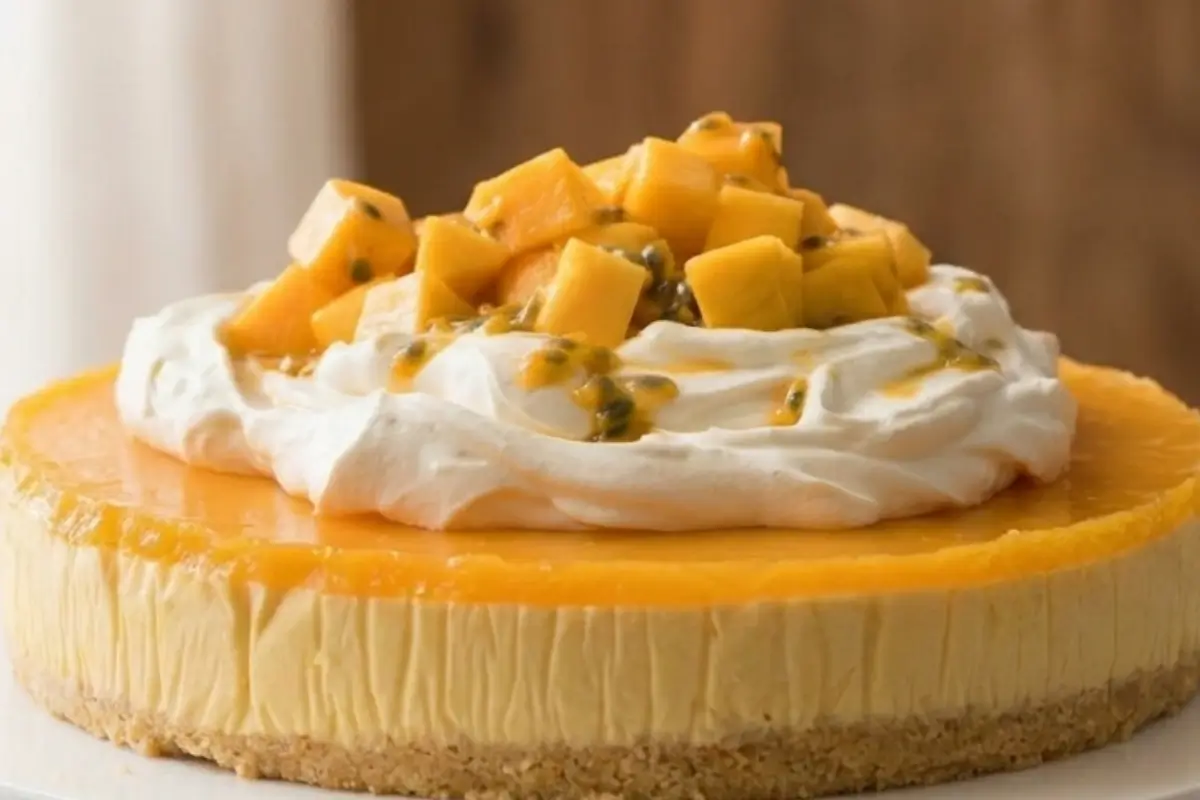
No-bake mango cheesecake changed the way I think about summer desserts. I still remember the first time I made it, not from an old Italian recipe passed down from Nonna, but from a single ripe mango I bought at the market on a sweltering afternoon when turning on my oven felt completely impossible.
It sat on my counter, golden and fragrant, and I thought, 'There has to be a way to turn this into something beautiful without the heat. 'An hour of mixing, a night of waiting, and a morning of the creamiest, silky, mango-golden slice I'd ever made, and just like that, this recipe found a permanent home in my kitchen.
That mango smell. That impossible colour. The way it looks like it came from a café window but came entirely from your hands. I've made it probably forty times since then, for summer gatherings, for birthdays, and for the days when I just want something that feels joyful without asking too much of me.
And today I'm sharing everything I know, including the steps other recipes skip, the reason so many no-bake cheesecakes refuse to set, and exactly how to get that real, deep mango flavour every time.
There's a reason this recipe has a reputation for going wrong, and I want to address it right here at the top so you can relax: the version you're about to make is designed to set, to taste like real mango, and to look like something you'd frame if that weren't a little strange.
I've spent time with the questions people ask: why won't it firm up? Why does it taste faint? Why is the crust crumbling? And I've built every answer into this recipe.
You don't need an oven. You don't need gelatine. You just need the right approach, and I'm going to walk you through it step by step.
What You'll Need for No-Bake Mango Cheesecake
This part is less complicated than it looks, I promise. But understanding why each ingredient is here is exactly what separates a cheesecake that sets beautifully from one that stays forever soft. Let's go through them together.
For the crust:
200 g (about 2 cups) graham crackers or digestive biscuits, crushed to fine crumbs. I've made it with both, and I honestly prefer digestive biscuits for a slightly less sweet, more buttery base. Graham crackers work beautifully too. Either one is right.
90 g (6 tablespoons) unsalted butter, melted. This is the binding agent, and the ratio matters. Too little and your crust crumbles when you slice. Too much and it turns greasy. Six tablespoons for two cups of crumbs is the number I trust.
For the filling:
90 g (6 tablespoons) unsalted butter, melted. This is the binding agent, and the ratio matters. Too little and your crust crumbles when you slice. Too much and it turns greasy. Six tablespoons for two cups of crumbs is the number I trust.
500 g (2 blocks, 8 oz each) full-fat cream cheese, softened to room temperature. This is the most important thing I will tell you in this entire recipe. Full-fat. Not light. Not reduced-fat.
Full-fat cream cheese is the structural backbone of this cheesecake. Light versions don't have enough fat to firm properly, and you'll end up with a slice that puddles on the plate. Take it out of the fridge an hour before you start.
240 ml (1 cup) heavy whipping cream, cold. The cream needs to be cold when you whip it. Cold cream whips to stiff peaks quickly and holds its structure. Warm cream won't cooperate, and without gelatine holding things together, the structure of this cheesecake depends entirely on properly whipped cream.
120 g (½ cup) powdered sugar, sifted. Just enough sweetness without overwhelming the mango.
1 teaspoon pure vanilla extract
1 tablespoon fresh lime juice. This is my secret. A little lime wakes up the mango flavour and stops the filling from tasting flat. Don't skip it.
For the mango layer:
400 g (about 1½ cups) mango puree. Here's where I want to be honest with you, because most recipes aren't. Not all mangoes are created equal. Fresh ripe Alphonso or Ataulfo mangoes give you an intensely fragrant, deeply sweet puree that almost glows orange.
Frozen mango works well thaw it completely and blend until smooth. Canned mango puree (look for the Kesar or Alphonso variety on the label) is a genuinely good option when fresh mangoes aren't in season, but taste it before you use it. If it tastes watery or faint, a squeeze of lime and a pinch of salt will bring it back to life.
A note on gelatine: This recipe does not use gelatine. When the cream cheese is full-fat and at room temperature, and when the heavy cream is whipped to stiff peaks, this cheesecake sets firmly overnight without any gelatine at all. I've tested both versions side by side.
The gelatine-free version has a creamier, more luxurious texture. If you prefer a very firm slice (useful if you're transporting it or making it in a warm kitchen), you can bloom one teaspoon of unflavoured gelatine in 2 tablespoons of cold water, melt it gently, and fold it into the filling. But honestly? Most of the time, you won't need it.
Dairy-free option: Replace the cream cheese with full-fat coconut cream cheese (the kind sold in blocks), and swap the heavy cream for full-fat canned coconut cream, chilled overnight and skimmed of the solids. It tastes tropical and wonderful.
How to Make No-Bake Mango Cheesecake Step by Step
Take a breath this is simpler than it looks, and I'm going to be right here with you through every step.
Step 1: Make the Biscuit Crust
Crush your biscuits to fine crumbs. A food processor makes this effortless, or place them in a zip-lock bag and use a rolling pin (which is honestly therapeutic). You're looking for fine, sandy crumbs, not chunky pieces.
Pour the melted butter over the crumbs and mix until every crumb looks damp and the mixture holds together when you press it between your fingers. If it looks too dry and powdery, add another teaspoon of melted butter.
Press the mixture firmly into the base of a 9-inch springform pan. Use the flat bottom of a glass or measuring cup to press it evenly don't be gentle here. The more firmly you press, the cleaner your slices will be. You'll know it's right when the crust feels compact, and no crumbs lift when you run your finger across it.
Refrigerate while you make the filling. Cold butter sets as the crust chills, and a pre-chilled crust makes assembly cleaner.
If yours looks a little uneven around the edges, that's completely normal. It will be covered by filling.
Step 2: Make the Mango Puree
If you're using fresh or frozen mango, blend the mango pieces until completely smooth. Pour the puree through a fine mesh strainer and press it through with a spoon to remove any fibres. This extra step is what gives you that silky, café-quality finish.
Stir in the lime juice and taste. It should taste bright, fragrant, and clearly of mango. If it's faint, a small pinch of salt and another squeeze of lime will bring it forward. Set aside about ⅓ cup of the puree you'll swirl this into the top of the filling for that gorgeous marble effect.
Step 3: Whip the Cream Cheese Filling
Here's the part everyone overthinks, but you won't.
In a large bowl, beat the softened cream cheese with an electric mixer on medium speed until it's completely smooth and lump-free, about 2 minutes.
This step cannot be rushed if the cream cheese is still cold; it will never be smooth, and those tiny lumps will become a grainy texture in your finished cheesecake. I learned this the hard way, so you don't have to.
Add the powdered sugar, vanilla, and lime juice and beat again until combined.
In a separate cold bowl, whip the heavy cream to stiff peaks. When you lift the beaters, the cream should hold its shape without drooping. This takes about 3-4 minutes on medium-high.
Gently fold the whipped cream into the cream cheese mixture in three additions, using a large spatula and slow, sweeping movements.
You're preserving those air pockets that give the filling its cloud-like, billowy texture. It should look thick, airy, and almost cloud-like. If it looks loose and pourable, your cream likely didn't reach stiff peaks. Pop the whole bowl in the fridge for 20 minutes and fold again.
Step 4: Add the Mango and Assemble
Fold the larger portion of mango puree (about 1 cup) into the cream cheese filling. You can fold it fully for a uniform mango filling or fold it just a few times for a beautiful swirl. I love a swirl it looks like something you'd see in a bakery window.
Pour the filling over your chilled crust and smooth the top with an offset spatula or the back of a spoon.
Drop the reserved ⅓ cup of mango puree in small spoonfuls across the top and use a toothpick or skewer to swirl it into a marble pattern. Don't over-swirl five or six gentle figure-eights are enough. You want it to look naturally beautiful, not stirred.
If the top looks a little imperfect, it will smooth out slightly as it chills. Don't worry.
Step 5: Chill (The Step That Cannot Be Rushed)
Cover the pan loosely with plastic wrap and refrigerate for a minimum of 6 hours. Overnight is what I always recommend, and here's why: the cream cheese needs time to firm around the whipped cream structure.
At 4 hours, it might look set but collapse when you remove the pan ring. At 6 hours, it's getting there. Overnight? It's firm, beautifully set, and ready to slice.
I know the waiting is the hardest part. But this is the step that turns a soft, disappointing puddle into a firm, gorgeous, slice-ready cheesecake. It's worth every hour.
Why This Recipe Works
This is the part I wish more recipes explained because understanding the why is what makes you a confident baker, not just a recipe follower.
Full-fat cream cheese is doing the structural work. It provides enough fat-based firmness to hold the cheesecake together once chilled. Light cream cheese is mostly water, and water doesn't set the same way.
Cold whipped cream adds the set without gelatine. When cream is whipped to stiff peaks, the fat molecules form a stable network that holds shape under refrigeration. Combined with the firm cream cheese, you get a cheesecake that sets firmly without any gelatine.
Concentrated mango puree = real mango flavour. Watery puree dilutes the filling and produces that faint, disappointing mango taste people complain about. A thick, strainable puree or a canned variety with real density gives you the deep, fragrant flavour that makes people ask for seconds.
Overnight chilling is non-negotiable. The filling continues to firm for a full 12 hours. Slicing too early is the single biggest cause of "my cheesecake didn't set" reports. Give it the time it needs. It will reward you.
This works without gelatine when you follow the method exactly. If you deviate lower-fat cream cheese, under-whipped cream, short chill time gelatine becomes necessary. Follow this recipe as written, and you won't need it.
Elena's No-Fail Tips for the Perfect Mango Cheesecake
Here's where I answer the questions I see asked most often because the best recipe is one that leaves you with no surprises.
Why Isn't My Cheesecake Setting? (And How to Fix It)
This is the question I see everywhere, and it almost always comes down to one of three things: the cream cheese was light or reduced-fat, the heavy cream wasn't whipped to stiff peaks, or the cheesecake didn't chill long enough.
Check all three before panicking. If your cheesecake is still quite soft after 8 hours in the fridge, here's your rescue move: Remove any fresh fruit topping, cover the pan tightly, and place it in the freezer for one hour.
Take it out, let it sit at room temperature for 10 minutes, then unmould and serve. It'll have the texture of a semifreddo: cold, creamy, and surprisingly wonderful.
How Do I Get Clean, Beautiful Slices?
Run a sharp knife under hot water for 30 seconds, dry it completely, then make one swift, confident cut. Wipe the blade clean between every slice. It sounds fussy, but it takes 10 extra seconds and makes your cheesecake look like it came from a bakery window entirely worth it.
Can I Use Canned Mango Puree?
Absolutely, with one small note. Not all canned mango purees are equal. Look for a brand that uses Alphonso or Kesar mangoes specifically; these varieties have the sweetest, most fragrant profile. Before adding it to your filling, taste it.
If it seems watery or faint in flavour, stir in a small squeeze of lime juice and a tiny pinch of salt. You'll be amazed how much those two things amplify the mango.
Do I Really Need a Springform Pan?
A springform pan makes unmolding effortless and gives you those clean, professional sides. But if you don't have one, line a regular 9-inch round pan with parchment paper, leaving enough overhang to lift the cheesecake out.
The sides won't be quite as pristine, but the taste is identical. For individual mini cheesecakes, silicone muffin cups or small ramekins lined with parchment strips work beautifully, and they're easier to serve than you'd think.
Saving a Little Joy for Tomorrow
Good news: this cheesecake is an effortless make-ahead dessert, which makes it the perfect choice for entertaining.
Refrigerator: Covered with plastic wrap or a cake dome, this cheesecake keeps beautifully for up to 4 days. The flavour actually deepens by day two.
Freezer: Yes, this freezes wonderfully. Freeze the whole cheesecake (without toppings) covered tightly in plastic wrap and foil for up to one month. To serve, transfer to the fridge the night before and let it thaw slowly overnight. Individual slices can be frozen the same way wrap each one tightly and thaw in the fridge for a few hours.
Make-ahead tip: This is genuinely one of my favourite party desserts specifically because it has to be made the night before. There's nothing to assemble on the day. Nothing to stress over.
Just unmould, top with fresh mango cubes or a drizzle of extra puree right before serving, and carry it to the table looking like you barely tried.
Add any fresh fruit toppings only when you're ready to serve fresh mango placed too far in advance will weep and make the top look soggy.
Variations Worth Trying
Once you've made the original, here are three twists that have earned serious attention in my kitchen:
Mango Coconut Cheesecake: Add ¼ cup toasted shredded coconut to the crust crumbs and substitute half the heavy cream with full-fat coconut cream (chilled and skimmed). Finish with toasted coconut on top. It's tropical, creamy, and completely irresistible.
Mini Mango Cheesecakes: Press the crust into the bottoms of 12 individual silicone muffin cups, fill with the mango cream cheese filling, and chill overnight.
Unmold and top each one with a single mango cube and a tiny mint leaf. These are showstoppers for parties, and people love having their own individual dessert.
Mango Passion Fruit Swirl: Replace half the mango puree with strained passion fruit pulp and swirl the two together on top. The tartness of the passion fruit against the sweet mango is one of the most beautiful flavour contrasts I know.
No Bake Mango Cheesecake
Ingredients
- 150 g plain sweet biscuits or digestives for base
- 100 g unsalted butter, melted for base
- 2 tablespoons white sugar for base
- 700 g mango flesh pureed
- 4 ½ teaspoons gelatin powder for filling
- ½ cup cold tap water for filling
- 500 g cream cheese, softened for filling
- ⅔ cup caster sugar for filling
- 1 ¼ cups whipping cream for filling
- ¾ teaspoon gelatin powder for mango jelly
- ¼ cup cold tap water for mango jelly
- 1 tablespoon lemon juice for mango jelly
- 1 ¼ cups whipping cream for toppings
- 1 tablespoon white sugar for toppings
- 1 teaspoon vanilla extract for toppings
- 1 large mango, cut into cubes for toppings
- 2 passionfruit for toppings
Instructions
- Prepare a 22 cm springform pan by turning the base upside down for easier removal later. Line the base with baking paper and grease the sides with butter.
- Make the biscuit base by pulsing the biscuits into fine crumbs in a food processor. Add the melted butter and 2 tablespoons of white sugar, and pulse until combined.
- Press this mixture firmly into the base of your prepared pan.
- Put the half cup of cold water in a heatproof bowl and sprinkle 4 1/2 teaspoons of gelatin over the surface. Let it sit for about five minutes until it gets thick.
- Melt the gelatin by microwaving it for 15 seconds, stirring, and microwaving another 15 seconds until completely dissolved. Let it cool for five minutes, making sure it stays liquid.
- Puree your 700 grams of mango flesh in the food processor until completely smooth. Measure out three-quarters of a cup of this puree and set it aside for your jelly topping later.
- Make the creamy filling by adding the softened cream cheese, 1 1/4 cups whipping cream, caster sugar, and the melted gelatin mixture into your food processor with the remaining mango puree. Pulse for about 30 seconds until very smooth.
- Pour this beautiful filling over your biscuit base and refrigerate for at least three hours so the top sets.
- To make the mango jelly, sprinkle the 3/4 teaspoon of gelatin over a quarter cup of cold water. Leave it for five minutes, then microwave in short bursts until dissolved. Let it cool slightly.
- Mix your reserved mango puree with the lemon juice, then whisk in the melted gelatin.
- Pour this directly over your set cheesecake filling and tilt the pan to spread it evenly.
- Let the whole cheesecake chill in the fridge for at least 12 hours.
- When you are ready to serve, whip the remaining cream with vanilla and sugar until soft peaks form.
- Swirl the whipped cream on top of your beautiful cheesecake and finish with fresh mango cubes and passionfruit pulp.
Notes
Making Sweet Memories
No-bake mango cheesecake came into my life not from Nonna's recipe box, but from a ripe mango and a very hot afternoon, and it's stayed ever since.
There's something about the colour of it, that deep golden orange against the white filling, that feels celebratory even on an ordinary Tuesday. It doesn't require the oven, it doesn't demand perfection, and it rewards patience with a slice that honestly tastes like summer.
You've got this. The hardest part of this recipe is waiting for it to set, and that's not really hard at all that's just the cheesecake doing its work while you rest. Leave it overnight. Wake up to something beautiful. Slice it with a warm knife. Watch everyone's face.
At AddCakes, we believe in memories, not masterpieces, and this mango cheesecake is somehow both.
Tell me in the comments: fresh mango or canned? I want to know your secret. 